Asimov
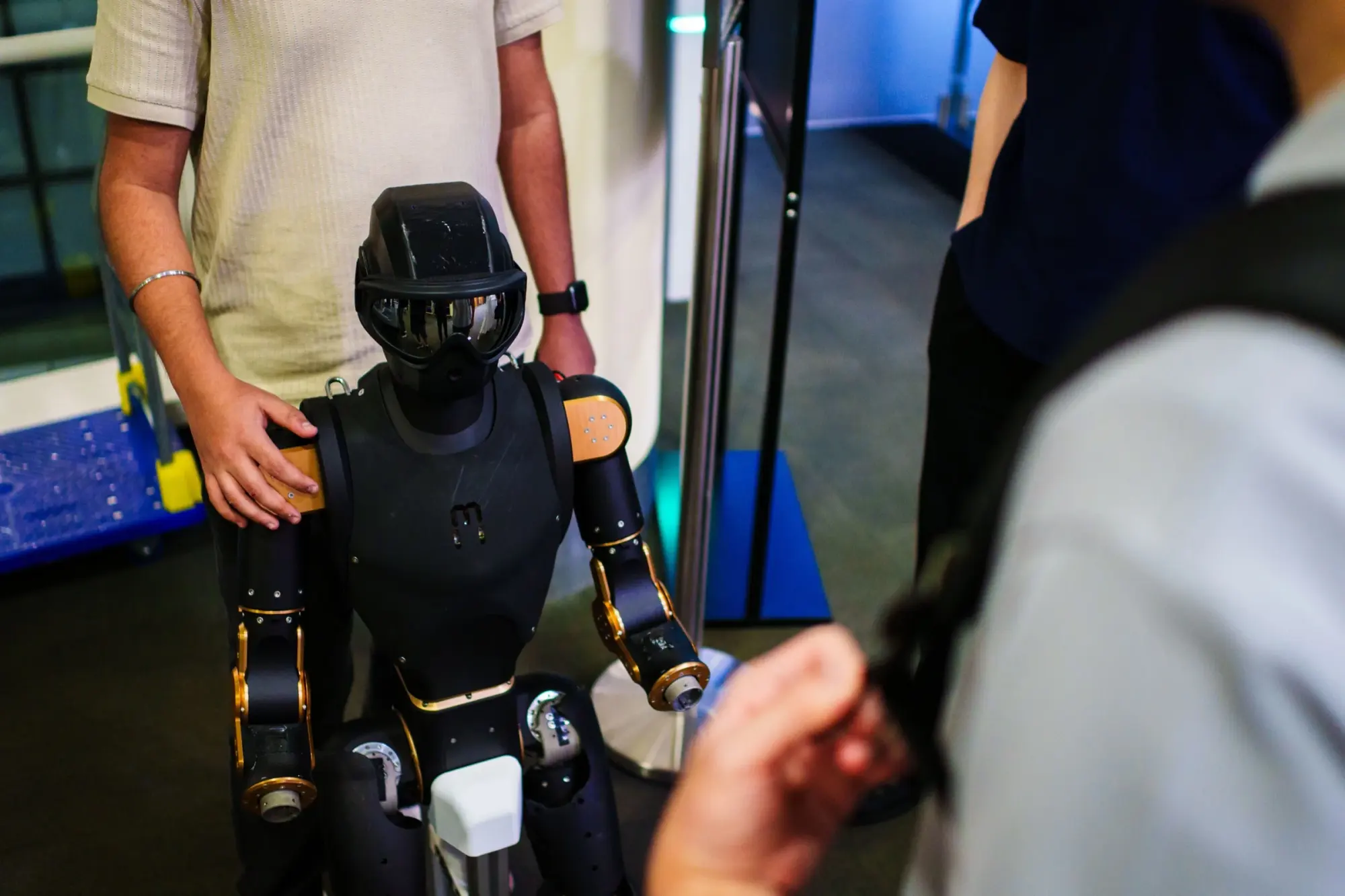
Asimov is Menlo’s open-source humanoid ecosystem. It consists of three interconnected components that together enable a humanoid labor force:
- Asimov OS — The operating system that runs on humanoid robots
- Asimov Humanoid — The open-source reference humanoid robot design
- Supply Chain — An open, permissionless ecosystem of component manufacturers and OEMs
Why name it Asimov?
Named after Isaac Asimov , the science fiction author who envisioned robots as helpers—machines that could serve humanity if designed with care. His Three Laws of Robotics remain a foundational framework for safe, beneficial machines:
3 Laws of Robotics
- A robot may not injure a human being or, through inaction, allow a human being to come to harm.
- A robot must obey the orders given to it by human beings, except where such orders would conflict with the First Law.
- A robot must protect its own existence, as long as such protection does not conflict with the First or Second Law.
We name our reference humanoid in that spirit: a robot that augments human capability rather than replacing it, built with safety, reliability, and purpose from the ground up.
The Menlo Stack in Action
Asimov demonstrates the complete Menlo Stack:
- Agent — An agent developer builds an agent in a standard framework. That agent is the autonomy payload.
- Skills — The agent learns motor skills (doing the dishes, dancing, manipulation) through real-world data.
- Simulation — The agent runs in a digital twin, validating behavior before physical deployment.
- Deployment — The agent is embodied into the robot with a single configuration step.
- Telemetry — Real-time feedback enables rapid iteration on the agent.
Last updated on